Quick answer: Roof moss in the Pacific Northwest is removed by hand-sweeping the heavy growth with a soft bristle brush, then treating what remains with a zinc-based product (Speaks uses zinc sulfate monohydrate) that kills the low-profile moss over the following weeks as rain washes it through. Pressure washing is not a safe removal method for composition or cedar roofs, even at reduced pressure marketed as “soft washing.” And because the PNW’s shade and moisture are exactly what moss needs, removal is recurring maintenance, not a one-time fix.
Why moss loves Western Washington roofs
Moss needs two things to thrive: moisture and shade. Western Washington delivers both most of the year. Any roof section that sits under tree cover, faces north, or simply dries slowly after rain becomes a candidate, and once moss establishes, it holds moisture against the roofing material like a wet sponge.
That’s the actual problem. Not the look of it, the moisture. A roof that never fully dries out stays damp longer after every rain, and composition shingles or cedar shakes both deteriorate faster under sustained moisture than they would in normal wear. Left unmanaged for years, moss-driven moisture damage is a real path to replacing a roof early.
What actually works
The method that removes moss without hurting the roof has two parts:
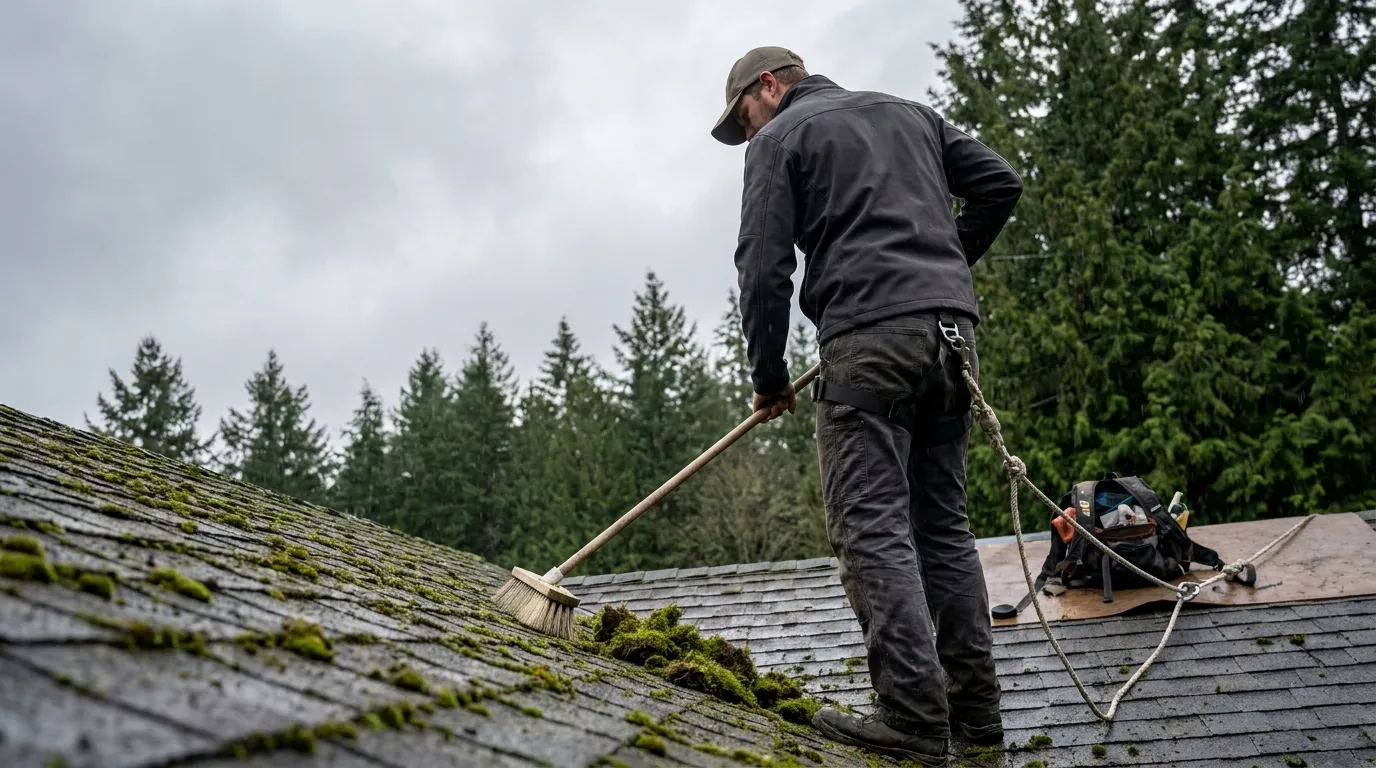
- Hand-sweep the heavy growth. A soft bristle brush clears the thick, established moss without disturbing the shingles or shakes underneath it. This is slower than machine methods, which is exactly why it’s safer.
- Treat what’s left. Zinc-based treatments (zinc sulfate monohydrate is the standard) kill the low-profile moss and lichen the brush can’t fully remove. The treatment keeps working over the following weeks as rain washes it through the remaining growth.
One thing an honest roof cleaner will tell you upfront: the roof will not look perfectly moss-free the moment the crew leaves. Some low-profile growth stays visible right after the visit, and the treatment finishes the job over the following weeks. If a company promises a spotless roof the same afternoon without pressure equipment, ask exactly how they plan to do that.
What doesn’t work: pressure washing, including “soft washing”
“Soft washing” is a real term in this industry, and it’s also a sales pitch. It still runs a pressure washer over the roof, just at a claimed lower setting, and it still compromises the surface:
- Composition shingles lose granules under pressure. Those granules are the shingle’s weather protection, and they don’t come back.
- Cedar shakes lose their weatherproofing layer.
Either way, water starts finding its way in faster than it should. A roof that’s been pressure washed a few times looks clean for a season and then ages faster than one that never was. This is why Speaks will not run pressure equipment across a roof under any circumstance, and will turn down work from customers who insist on it. (Driveways and decks are a different story, that’s the surface pressure washing is actually built for.)
What about zinc strips, or doing it yourself?
Zinc strips installed at the ridge line release small amounts of zinc as rain runs over them, which suppresses new growth on the roof sections below. They help as prevention on a roof that’s already been cleaned, but they don’t remove established moss, and their protection fades with distance from the strip.
DIY removal runs into two problems: the wrong tools (stiff brushes and scrapers damage shingles the same way pressure does, just slower) and the ladder itself. Roof work from a ladder, on a slick, mossy surface, is one of the more common ways homeowners get hurt working on their own house. If you do go the DIY route, use a soft bristle brush, work top-down so you’re not lifting shingle edges, and stay off any section that’s wet.
How often does this need to happen?
In this climate, plan on moss maintenance as a recurring item, roughly like gutter cleaning. How often depends on the specific roof: tree cover, orientation, and how much shade it sits in matter more than the calendar. A roof under heavy fir cover may need attention every year or two; a sun-exposed roof with no overhanging trees can go much longer.
The honest frame is maintenance, not cure. Anyone who sells a permanent fix for moss in the Pacific Northwest is selling something the climate doesn’t allow.
What it costs
Roof moss removal in the Woodinville and Eastside market typically runs $300 to $600 for a standard home, depending on roof size, pitch, and how much moss has built up. We publish our pricing rather than making you call for a ballpark: see the Pricing page for every service.
If your roof is showing green, we’ll tell you what it actually needs and what it’ll cost before we start: see our Roof Cleaning & Moss Removal service, or call (206) 228-5069.